
What Makes a Wine Estate Worth Living On
A lagoon-front wine estate on Walker Bay. Land in five Collections, held for a small number of families.
What Makes a Wine Estate Worth Living On? Here is an honest guide to the choice, written by people who do this for a living.
There is a particular kind of property listing that has appeared steadily over the last fifteen years in South Africa, in California, in the Mosel, in Tuscany, in Sussex.
The headline reads something like: A Home on a Working Wine Estate.
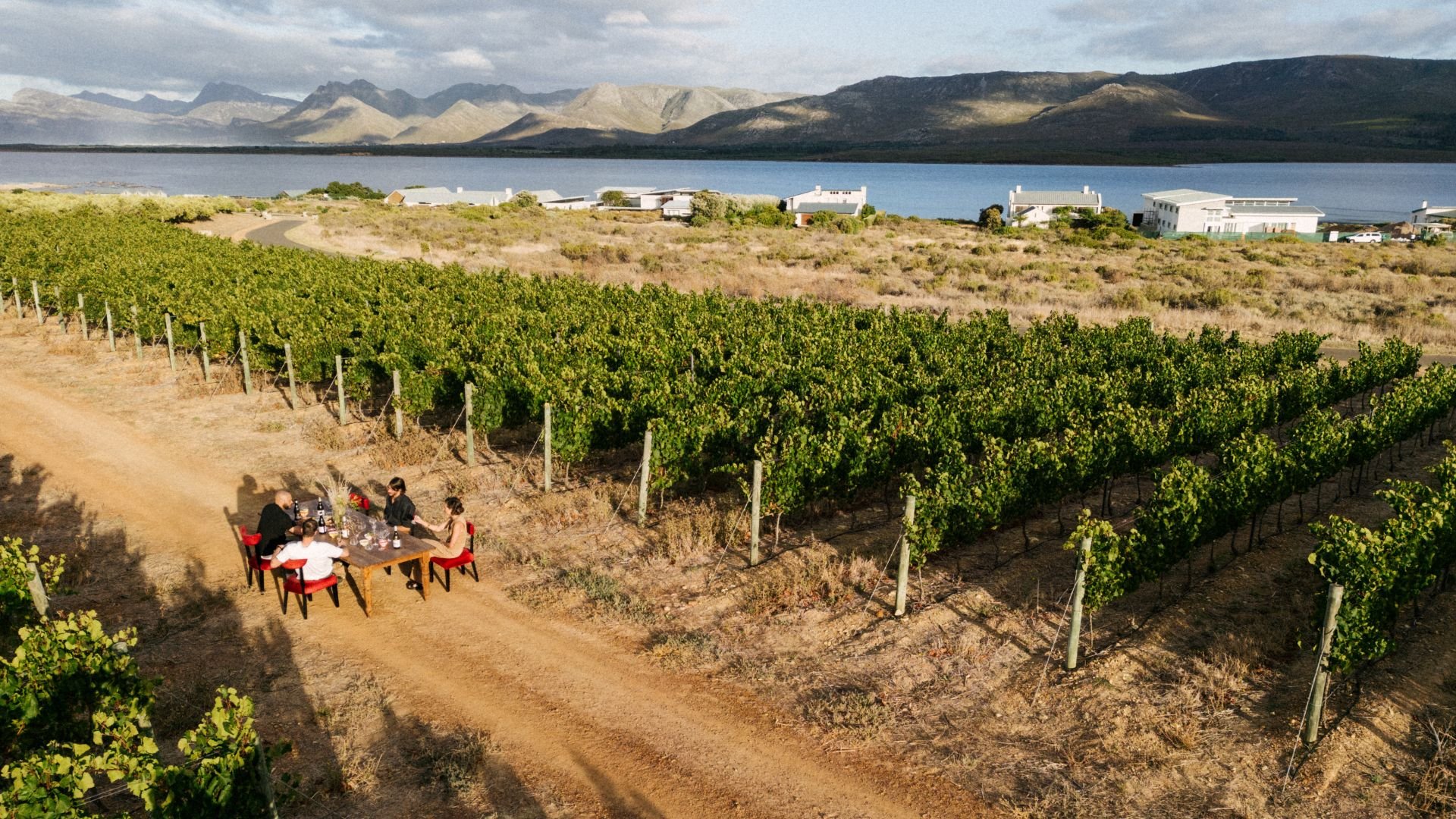
The image is always the same. A villa on a slope. Vines below. A glass of wine on a long table. A sunset.
The question this article tries to answer honestly is: what is actually being offered when you buy into one of these places, and what should you ask before you do?
We run a wine estate that sells plots. So we have a commercial interest in the answer being a positive one. We will declare that interest now, and then try to be useful regardless. If by the end of this piece you have decided that estate living is not for you, we will consider the article well spent.
Wine Estates Are Not All the Same Thing
The phrase "wine estate" covers a wide range of arrangements that have very little in common with each other.
At one end you have a vineyard owner who has decided to sell off some land for residential use. The wine is real, the operation is real, but the residential development is essentially a side business. You buy a plot, you build a house, you live next to a farm. The estate's identity is the wine; you are a neighbour to it, not part of it.
At the other end you have a residential estate that happens to have vines for marketing purposes. The vines are decorative. The wine is contracted out, branded, sold at a small loss as part of the estate's amenity package. You live in a community whose theme is wine, but the wine is a logo, not a business.
Most of the estates being sold to buyers today sit somewhere on this spectrum. The two ends produce very different experiences of ownership, and the distinction is rarely made clear in the brochures.
The honest test is to ask: if all the homes on this estate sold tomorrow, would the wine business continue? If yes, you are buying into a working estate where the wine matters. If no, you are buying into a residential development that uses wine as a brand. Both can be wonderful places to live. They are not the same purchase.
What You Get That Other Properties Cannot Offer
Assuming you are looking at a real working estate, here is what is genuinely on offer.
First, a connection to a seasonal year. Wine estates do not have an off-season the way a beach house or a golf estate does. Spring brings flowering. Summer brings veraison. Autumn brings harvest. Winter brings pruning. Something is always happening on the land outside your window. People who live on wine estates often say that the season-led rhythm is the thing they did not know they wanted until they had it.
Second, a place that is not solely about you. A wine estate has a purpose that exists independently of its homeowners. The vines were here before you arrived and will be here after you leave. This sounds like a small thing. Owners report that it is a large one. Living on land that has its own work to do is a quieter experience than living somewhere whose only purpose is to be enjoyed.
Third, a community shaped by shared interest. People who choose to live on wine estates tend to share something: an interest in food, in wine, in the slower forms of pleasure. The community is self-selecting in a way a suburban estate's is not. Whether this is an attractive feature depends on how social you want your neighbourhood to be.
Fourth, an asset class that ages well. A good wine estate's land does not depreciate. The vines mature, the wines develop reputations, the estate becomes more itself over decades. Property values on serious wine estates have historically tracked or outperformed comparable residential markets, though as with any property class this depends on macroeconomics, location, and the quality of the operation.
What You Should Be Honest with Yourself About
This is the section most articles like this leave out. Honesty serves everyone, including us.
Wine estates are not quiet. Tractors run at six in the morning. Harvest is loud. Sprayers pass. Workers are in the vines at dawn. If you are imagining the silence of a private country house, that is not what you will get. You will get the soundscape of a working farm with the volume turned down. People who have grown up in cities sometimes find this more sound, not less, than they expected.
Wine estates are seasonal in their hospitality.
The places that brought you to the estate (the restaurant, the tasting room, the events) are quieter in winter and busier in summer. Your favourite Thursday lunch venue may be closed for August. Worth checking what is open year-round and what is not.
Wine estates have other people on them. You are not buying a private retreat. You are buying into a place that hosts visitors. Some buyers love this; they enjoy the rhythm of guests and the energy of a place with public life. Others find that an estate with twelve weddings a year and a wine club open on weekends is more populated than they had hoped. Ask how much of the estate is publicly accessible, and on what days.
Wine estate homes are subject to architectural review. Most working estates have an architectural framework that owners build within. This protects everyone's investment in the estate's appearance. It also means you cannot build whatever you like. If you have a specific architectural vision, check the framework before you commit.
Wine estate levies are not optional. Like any community-managed property, wine estates charge monthly levies that cover shared infrastructure, security, conservation, road maintenance, and amenity operation. These are typically reasonable, but they are real. Ask for the levy schedule, and ask whether it has risen in the last five years and by how much.
Questions Worth Asking Before You Sign Anything
If you are seriously considering a wine estate purchase, here is the list we wish more prospective buyers brought with them:
Is the wine business profitable, or is it subsidised by the property sales? You can ask. The answer tells you a great deal about how the estate will look in ten years.
Who actually runs the estate's daily operations, and how long have they been doing it? A wine estate is a hospitality business as much as a viticultural one. Continuity of leadership matters.
What is the build framework, and how long do owners have to complete construction? Some estates require build within 18 months. Some allow five years. Some have no time limit. The answer affects your financing and your timeline.
What is included in the levy, and what is extra? Wine clubs, restaurant access, sailing lessons, golf, gym, security: some estates bundle everything, some charge for everything separately.
Is the estate a VAT vendor, and what does that mean for your transfer costs? In some jurisdictions a VAT-vendor estate saves the buyer the equivalent of transfer duty, which can be a meaningful proportion of the purchase price.
What is the resale market like? Ask the estate for recent resale data. If they cannot or will not provide it, that is itself a piece of information.
Who else owns here? Not the names, but the broad profile. Are these primarily local buyers, returning expats, internationals, retirees, families with children? The community profile is part of what you are buying.
What conservation responsibilities come with ownership? If the estate is in a sensitive ecological area, there may be obligations attached to your title deed about indigenous planting, fencing, fire management, and water use.
What is the worst thing about living here, in the honest opinion of an existing owner? Try to talk to someone who already lives there, not just the sales team. Existing owners are usually candid in ways that estate management cannot be.
The Deciding Factor
Most people who have lived on wine estates and stayed will tell you that the deciding factor was not the wine, the view, the architecture, or the investment case. It was the place.
They came once. They stayed for a long lunch. They walked the estate at six in the evening when the light was changing. They felt that the place did something to them. They came back. They eventually moved.
This is not romantic talk. It is a description of how serious property purchases of this kind actually happen, in our experience and in the experience of every estate operator we know.
The implication is that no article can settle the question for you. The question is whether the specific place, with its specific light and air and people, is somewhere you want to live the rest of your life. That can only be answered on the ground.
If you have read this far, the next step is not another website. It is to choose two or three estates you are seriously interested in, and to visit them properly. Spend a day. Have a meal. Walk the land. Meet someone who lives there. Then decide.
People often ask what it is actually like to live on a wine estate, rather than simply visit one. My team at Benguela Cove wrote this honest guide, informed by running a working estate that sells plots as well as wine, to answer that properly.
Own a Piece of Benguela Cove
This article was written by the team at Benguela Cove Lagoon Wine Estate, a working wine estate on the edge of Walker Bay in the Western Cape. We have plots available across five Collections, from R9.5m. If after reading this piece you would like to visit the estate properly, our Sales Lead Nick Rea would be glad to host you.
Read more about Benguela Cove Lagoon Wine Estate, where I am the owner and where this guide comes from, or see my other ventures.
